
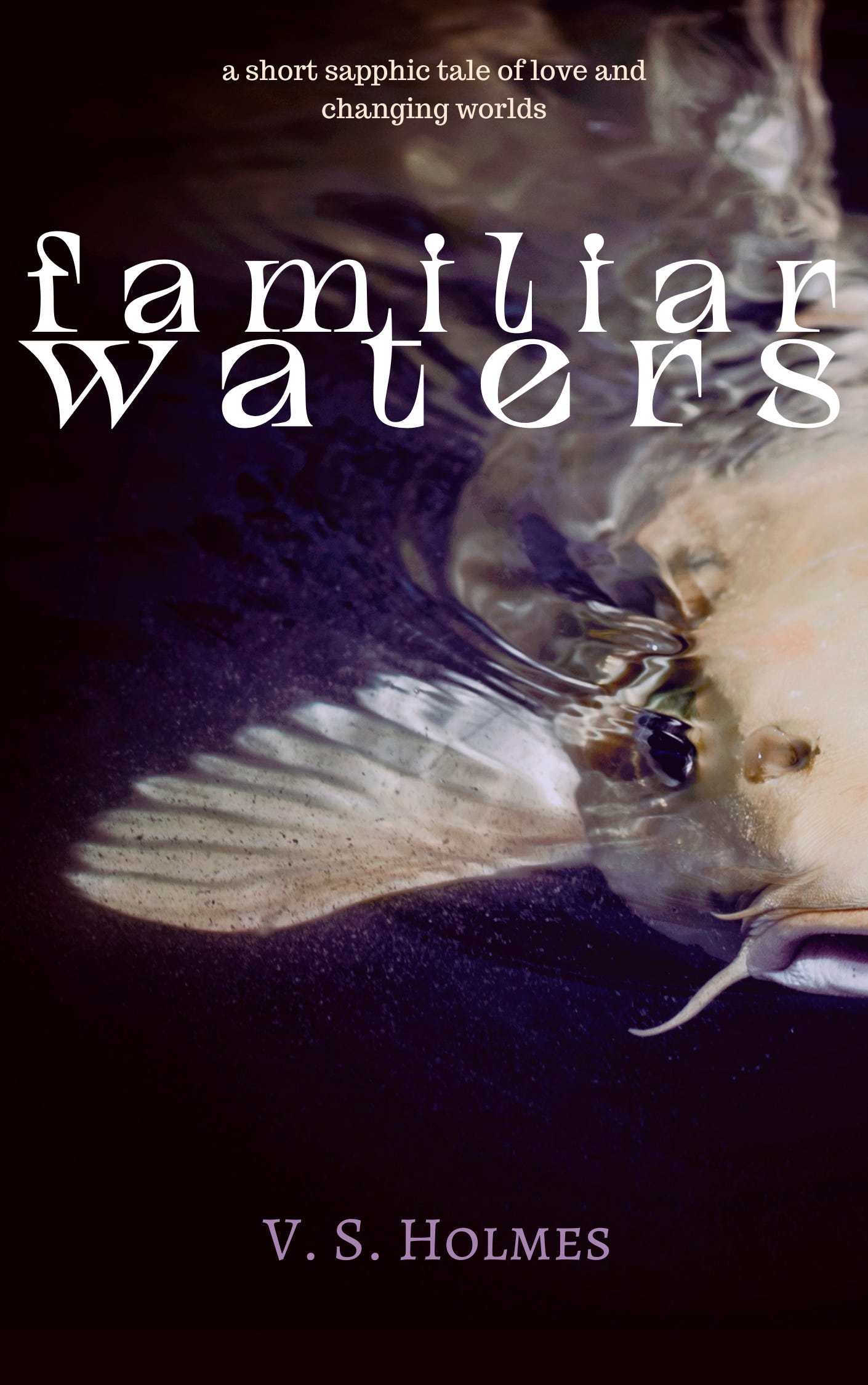
Familiar Waters
A short sapphic romance between a catfish goddess and her river spirit.

This sapphic short was originally published in Love and Bubbles, an underwater themed anthology. I’m sharing it here as it’s a bit too short to publish on its own. I hope you enjoy!
As a river spirit, Iguazú has weathered eons of change. She watched the rise of life on earth, the fall of the dinosaurs, and the flourish of the Amazon jungle she calls home. Best of all she fell in love with Bia, a catfish goddess. Every dry season Bia escorts her people to the ocean, and the pair part with the promise of reunion when the weather changes.
But in all her millennia, Iguazú has never seen weather like this. Global warming wreaks havoc on their home--animals grow scarce, trees die, and worst of all, the rains that bring her lover home come later every year. How can Iguazú remain hopeful when she may never see Bia again?
Silt dusted the walls of the cave, memories in the corners of a mind. Glittering. Weightless. The sound of water passing the door was no longer the languid mutter of summer over sun-hot cobbles. Iguaçu uncurled from the warmth of the mud, swirling and stretching, shaking sand from her skin. Beside her, Bia did not stir. Her gills fluttered faintly, smooth scales expanding in rest. The brown whiskers framing her mouth felt the change in the water as her lover rose and she turned back into the warmth of the mud. Iguaçu smiled. Bia was not an early riser. The river spirit wove through the tangle of roots that enclosed their home. It was dawn. Mist rose from her surface, breath eddying through the tree trunks along her shore. As much as habit drove her to patrol her banks, she dallied. This morning was different from the others. The rains end today.
Despite how her waters danced, Iguaçu’s heart was heavy. Summer was over. That night, with the rest of her people, Bia would leave. Iguaçu was no longer the jealous, quick, bitter river that she once was. She knew Bia would swim in other waters, ones that tasted of the ocean’s tang, or were steady and broad, so broad she could not see one bank from the other. But she would return. Iguaçu was the water of Bia’s home.
“Good morning, Zu.”
Iguaçu turned, smiling. “I didn’t mean to wake you.”
Bia’s scales rippled in a gentle shrug. “It’s hard to sleep the night before a Voyage anyway.” Her eyes were the deep brown of river’s mud, dotted with gold like silt. “So many thoughts from my people, and they crowd my mind. They’re excited.”
Iguaçu watched her lover creep from the coziness of the mud and into the shaft of sunlight growing across the river bed. The light ignited the gold in Bia’s dapples, turned her pale belly pearlescent. Her muscles flexed, bunched under her skin, preparing for the journey to come. Still, her body had not shed its usual peace. “I thought I heard the tucans fledglings learning to fly yesterday.”
Iguaçu nodded, unwilling to interrupt the soft sound of Bia’s voice yet.
“This is their fourth clutch here, I think. Maybe their fifth. Soon their chicks will have their own nests above your banks.” She stretched, her fins fluttering faster now, in the sun’s warmth. “Though I would appreciate if they understood the concept of sleeping in.”
Igauzu chuckled, the sound already carrying autumn’s sharpness.
Bia swirled in the eddy of her lover’s laugh. “Do you remember when we first met?”
Iguaçu did. “My banks were narrow and steep. The hills were mountains and the trees just prairie.” She smiled. The world had been different, great saber-cats and giant sloths grazing where tapir and capybara now roamed. “You were younger too, leading your people to my waters.” She caressed the dappled scales, smooth from wear now, rather than youth.
“And I tried to make you come with me in winter.”
“And I tried to make you stay.” Iguaçu dove into the cold of the deep channel, feeling Bia follow, fins fluttering, body sinuous along the sand. “I did not realize what made you leave is what made me love you, then.”
Bia’s expression stilled. “Swim with me?” It was their tradition on the last day of summer.
Iguaçu curled around Bia’s fin. “Until the hills are plains and my banks are dry.”
The day still held enough warmth of summer to make Iguaçu warm, her current slow and peaceful. It suited the day, for she was in no hurry for nightfall. They wove through the cool pockets of weeds, rested in the warmth of the mud along her curves. Iguaçu led them past the soft noses of capybara and under the shadow of jaguar. Already the echo of the falls rumbled from far ahead. Bia slowed. It was not time to visit the falls, not yet, not until tonight. Iguaçu felt Bia’s people stirring, gathering. She looked back at the catfish goddess. Her gaze was distant.
“What are you thinking of?” Iguaçu asked.
“We are fewer than we used to be. And the waters are changing. Not just yours.”
“They change every year.” Iguaçu promised.Bia was old, but not as old as Iguaçu. The animal gods were a younger people, and came after the spirits of the rocks and rivers. Iguaçu had lived through many changes in her pocket of the rainforest. One of those changes had brought Bia and her people swimming up her waters. What if one day another change keeps them away? The fear was an old one, and its edges dulled by familiarity.
Bia turned, her eyes catching the sorrow in Iguaçu’s. “Zu.” Her tone was soft. She moved closer, her lips finding the river spirit’s. The first kiss was tender, the second strong. It drove away Iguaçu’s concern. They did not speak, but Igauzu felt the flutter of promise through Bia’s skin. I’ll come back. Her whiskers caressed the edges of Iguaçu’s face, memorizing the details of her features. Iguaçu wrapped herself around Bia, feeling the strength of her fins before pulling away. Shadows stretched from her western banks now. Their time was short. “Come home with me? Just until dusk?”
Bia smiled, her cheeks pink, her mouth full from kissing. “Always.”
~~~
The cave was quiet. Silt and sand still eddied from their love-making. Iguaçu watched Bia rise. Her muscles tensed with anticipation. It was as if Iguaçu’s touch had stripped the stillness from her lover’s skin. Now Bia hummed with energy. In the moon-dappled water beyond her people waited. She pressed a fin to Igauzu’s cheek, but did not say a word. It was as if her impending journey swallowed her voice first.
Igauzu did not mind. They did not need words. She followed the catfish goddess into the deeper channel. The trees were lace across the moon’s face. Already, Igauzu’s current quickened. Rising water kissed Bia’s skin as it carried her towards the falls. The cataracts had multiplied, swollen with summer’s rain. The rumble turned to thunder and then a deafening roar. Iguaçu paused at the crest of the tallest, clinging to the rocks as her waters rushed past and over into the mist below. She turned to Bia, poised beside her, body taught. They kissed again, not a goodbye but an ellipses.
Clear membranes slid over gold irises. Bia turned and pitched herself into the current. The moonlight glittered off of brown scales, slid along the sinuous backs of Bia’s kin. They crowded about her, surging after their goddess. Iguaçu wrapped herself around the tree roots, grounding herself against flooding after them into Parana’s roaring waters. A river cannot weep, but Iguaçu swore her current was saltier. Until spring, beautiful voyager.
The moon had set and her waters were dark. Dark so dark she could taste it. She turned upriver. It was not dawn, but she could not rest. Her cave was too empty, the mud cold, the walls dull without the light off Bia’s scales. The roots cramped her banks and she ripped herself away, white froth spattering her surface. The water jabbered, hurried with a purpose that was the vanguard to winter’s chatter.
Beyond, Bia swam, gliding out into the icy dark, only deep blue-black ahead.
~~~
The river changed from its burble and snap to a desperate trickle. More mud than water. The animals that often made her waters their home moved east in favor of deeper water, wider banks. Such things often happened during winter. But something was different this year. Iguaçu had not heard the jaguar’s call in a long time. She counted the days as much as trees counted centuries, rocks counted millenia. Now she wondered if she should start. Winter seemed to last forever. Her waters grew warm, the mud at the edges dull, cracked like the reflection of the moon on her surface. Still, the rains did not come. The tucans made their first nest—only a single egg. The hoya hanging from the trees shriveled, their waxy petals curled shut before it could bloom. The clouds did not gather.
Then the tree over her home fell.The crack deafened, the graon and scream of wounded wood drowning even the started cry of the howlers as they scattered. She churned, as much from confusion as disruption and grief. She surged tot he surface, staring at the broken roots, the thirsty yellowed leaves. The tapir god paused at the battered, shattered trunk, where the green wood was sick and bright.
“What happened?” She knew, very well now, that it was not her impatience that made the rain seem late.
“There’s not enough water. What nutrients left are locked in the mud.” His dark eyes held resignation. “Our sisters tell me there’s water further to the ocean, but the storms there beat the trees and waves too fiercely. Our brothers in the mountains say winter comes sooner, and lasts longer each year.”
Her heart thundered, but she tried to hide the fear from her eyes.
The tapir god’s expression softened. “The rain will come, I’m sure. It’s just late.”
Later every year, though. Waves trembled against her banks. If there’s not enough water for the trees, for the animals, how can Bia come home? She did not speak it aloud, too afraid it would echo in the ripple of her water and become truth. When she was able to see through the shaking surface, the tapir was gone too, his tracks leading east. That night as she drifted, quiet under the no-moon sky, she dreamt of darkness and the cool brush of a gold-brown fin.
~~~
Sand settled between Iguaçu’s toes. Mud clogged the entrance to her house, fillingthe gaps torn from the uprooted tree. The days wore on and the sun rose early, warming her waters and painting her banks with light. Her patrol took her past the new tucan nest, between the roots of the saplings encroaching on her backwaters, under the rotting length of her tree. A new island rose from her winter-low waters downstream, already home to sunning capybara and caimen. She pushed out, farther, waters curling with the force of her current. The falls were a faint mutter, steady and slow. A second rumble came. Then again, closer. What fish and salamander styaed in her waters rushed past, tucking themselves into crevices and under rocks. Crack-boom. Iguaçu rushed upriver, peering at the mountains suddenly shrouded in dark, in thick clotted clouds. Rain! The water inched up her banks, then surged forward, white and full of mountain flavor. Iguaçu forgot how it felt to have her heart race, her banks reshaped under hopeful hands of summer. She let the current take her, rushing towards the ocean. At the falls she stopped, curled against a sunwarmed rock. She strained to see through the mist and clouded water.
There! The flash of gold came again, the flick of brown scales through churning water. Iguaçu grinned. She tasted ocean’s salt, the cold of deeper waters carried upriver. Now sunlight struck gold from the backs of a dozen of Bia’s kin. No, a score. No, a hundred. Between a thousand flashing fins Iguaçu picked out the dappled curve of her lover’s body. She rushed forward, reaching down the tumbling falls to brush closer to Bia as she leapt up and up and up. The goddess finally surged over the rocks, gills heaving, sides full and strong from swimming in foreign waters.
Iguaçu paused, eddying and shy for a moment. Her heart thundered like the falls in summer, threatening to overflow her banks from joy and relief. She had myriad questions for her lover, about the different skies she had swum beneath, the different fish. When Bia’s gaze finally settled on her, however, the questions stilled.
The goddess’s mouth curled into a bright smile, brighter than the gold flecking her eyes. She reached out a fin. “Swim with me?”
I hope you enjoyed that little glimpse into another world! As always, happy reading and take good care.
-V